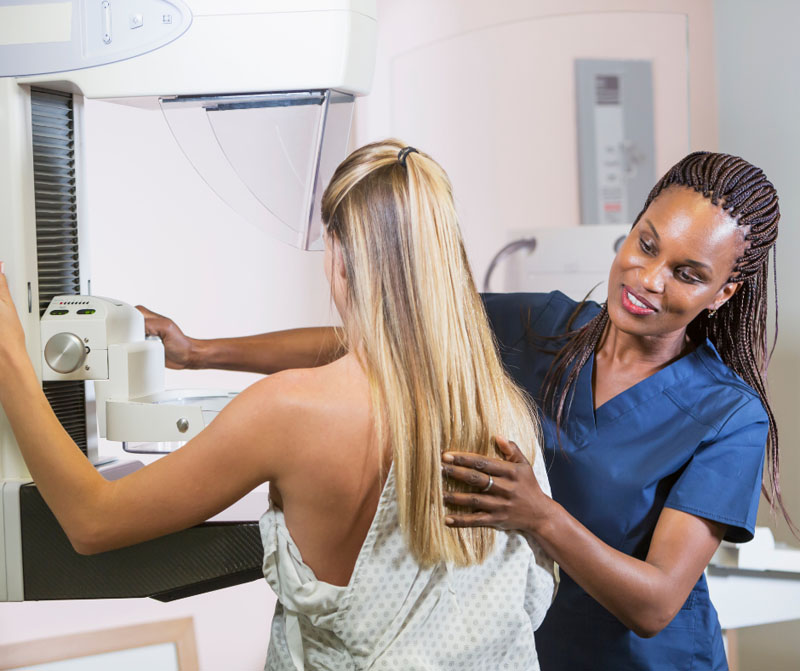
Understanding your breast density is a crucial part of assessing your overall breast cancer risk and making informed decisions about your long-term breast health. While you may be familiar with how your breasts normally look and feel through monthly self-exams, dense breast tissue is something you cannot identify by touch or sight alone; it can only be evaluated through mammography.
Approximately 50% of women over age 40 have dense breasts, and density levels can change from year to year. Knowing whether you have dense breast tissue is vital because it can complicate the evaluation and diagnosis of breast cancer and is linked to an increased risk of developing the disease.
What is Dense Breast Tissue and Why Does Density Matter?
Dense breast tissue refers to the composition of the breast, which includes milk glands and ducts, connective (fibrous) tissue, and fatty tissue. When your radiologist talks about breast density, they’re referring to the balance of these components — how much is glandular and fibrous compared to fatty tissue.
Breast density plays an important role in how well mammograms can spot potential issues and can also affect your risk for breast cancer. The only way to really know your breast density is through a mammogram. A regular check-up and physical examination won’t give you the full picture.
Types of Dense Breast Tissue: The BI-RADS Classification
Radiologists categorize breast density using the Breast Imaging Reporting and Data System (BI-RADS) scale, developed by the American College of Radiology. This system rates density into four lettered categories.
- A — Almost Entirely Fatty Tissue: The breast consists almost entirely of fatty tissue (found in about 10% of women).
- B — Scattered Fibroglandular Tissue: Most of the breast is fatty tissue, with scattered areas of glandular and connective tissue (found in about 40% of women).
- C — Heterogeneously Dense: Most of the breast contains dense glandular tissue, but some fatty areas are present (found in about 40% of women).
- D — Extremely Dense: The breast is made almost entirely of connective and glandular tissues, containing very little fatty tissue (found in about 10% of women).
If your results fall into categories C or D, you are considered to have dense breasts. New regulations require mammogram reports to explicitly state whether a patient’s breasts are dense or not dense and include information about the density findings. Supplemental screening options, as well as more frequent screenings, may be recommended as part of your breast health journey.
What Causes Dense Breast Tissue?
Researchers are still working to fully understand what causes dense breast tissue, though genetics are known to play a role.
Density is not static; it can change over time. Several factors are known to increase the chances of having higher breast density:
- Age: Women who are younger are more likely to have dense breasts, as breast density tends to decrease as you age.
- Low Body Weight: Individuals with a lower body weight or low body fat levels have an increased chance of having more glandular and fibrous tissue.
- Hormonal Changes: Elevated levels of hormones, such as those during pregnancy and breastfeeding, can increase breast density. Hormone replacement therapy (HRT), used for menopause symptoms, which replaces estrogen and progesterone, can also lead to denser breast tissue.
Dense Breast Tissue and Increased Breast Cancer Risk
Dense breast tissue is considered a risk factor for breast cancer. Women categorized as having higher breast densities (categories C and D) are associated with an increased risk for breast cancer compared with those who have lower densities. Other known risk factors include inherited genetic mutations, a family history of breast or ovarian cancer, and getting older.
The Masking Effect: Why Dense Breasts Make Finding Cancer Harder
A major concern with dense breast tissue is the challenge it poses during detection. On a mammogram, both dense breast tissue and small tumors or other breast abnormalities appear white. In contrast, fatty tissue appears dark. This similarity in appearance creates a “masking effect,” making it difficult for radiologists to distinguish cancerous tumors from the surrounding dense glandular tissue. Therefore, dense tissue can conceal early-stage cancers, making them more difficult to detect through mammography alone.
Your Dense Breast Tissue Questions Answered
Can Dense Breast Tissue Turn into Cancer?
Having dense breast tissue is a risk factor that increases your overall likelihood of developing breast cancer.
Can Breast Density Be Reversed?
You cannot reverse or get rid of dense breast tissue. However, density is known to change over time, typically decreasing as you age or change weight. The most important step is to educate yourself about your breast cancer risk factors and remain current with your annual screening mammograms.
What Are the Symptoms of Dense Breasts?
There are no visible signs or physical symptoms that indicate you have dense breast tissue. Breast density can only be determined by a mammogram.
At What Age Does Breast Tissue Become Dense?
Breast density is more common in younger women because density tends to decrease as women age. However, around 50% of women over age 40 still have dense breast tissue.
What Kind of Mammogram Should You Have if You Have Dense Breasts?
For screening, annual 3D digital mammography (also known as digital breast tomosynthesis) is the recommended standard of care for early detection. Through advanced imaging technology, 3D mammography captures “slices” of the breast to create a clearer, layered 3D view, which may be more effective at detecting cancer compared to 2D imaging. 3D mammography is also used for diagnostic imaging for more views of the breast tissue and to further evaluate any changes.
How Accurate are Mammograms with Dense Breast Tissue?
While dense tissue makes cancer detection more difficult, 3D mammograms can still detect most cancers in women with dense breasts. Radiologists who are subspecialized in breast imaging are trained to identify subtle irregularities in the images. Additionally, technology advancements in breast cancer screening combine advanced AI technology with 3D screening and diagnostic mammography for earlier detection of breast cancers, including those that are more difficult to find.
Because dense tissue increases the challenge of early detection with 3D mammography, women with higher breast density (categories C or D) may benefit from supplemental screening.
Supplemental Screening Options
Supplemental screening methods do not replace your annual 3D mammogram. Instead, these options are used in combination with 3D mammography to provide an additional layer of early detection for those who may need it. Talk to your medical provider to learn more and determine if supplemental screening should be added to your breast health plan.
- Screening Breast Ultrasound: This technology uses sound waves to create images of the breasts and can help further characterize changes in dense breast tissue.
- Breast Magnetic Resonance Imaging (Breast MRI): A Breast MRI uses radio waves and a magnetic field to produce high-definition images of soft tissue. For patients at higher risk, regardless of density, an annual screening breast MRI may be beneficial and is typically scheduled 6 months after a 3D mammogram.
Breast Density Insights With AI Technology
In healthcare, AI technology advancements are helping to improve early cancer detection rates, including breast cancer. Windsong integrates ProFound AI® technology with 3D mammography for the earliest breast cancer detection. Our subspecialized radiologists utilize AI in imaging to gain critical insights to inform their clinical interpretation of your mammogram and help assess cancer risk. This advanced technology supports more personalized care so you can work with your physician to design a breast health screening plan that’s tailored to your unique needs, including your breast density. The power of AI plus Windsong’s subspecialized expertise gives you and your physician the knowledge to inform your best breast health.
Key Takeaways About Dense Breast Tissue
Being breast aware is crucial for understanding your body’s unique characteristics and recognizing any changes that may occur. Here are some key takeaways about dense breast tissue:
- Knowing your breast density is essential in evaluating breast cancer risk and can only be measured through mammography.
- If you find that you have dense breast tissue, discuss this with your healthcare provider for guidance on additional screening options and personalized strategies for monitoring your breast health.
- Breast density can fluctuate over time due to factors such as age and hormonal changes, so it’s essential to stay vigilant with self-exams, well-visits, and annual mammograms.